From December 18 until December 23, thousands of people will
assemble at sunrise outside the entrance to Newgrange, an ancient Passage Tomb
in Ireland's Boyne Valley. Fifty of them, chosen by lottery from among 30,475
ballots in 2015, will get access to the inner chamber of the tomb.


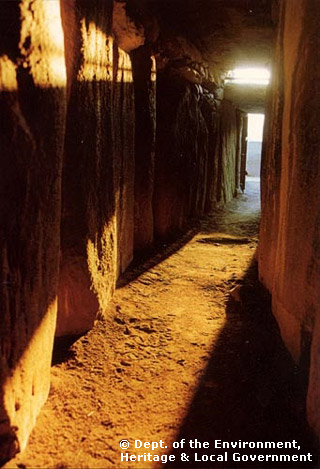
The rays enter through a roof box located just above the main door to Newgrange. They travel down the corridor and gradually illuminate the inner chamber, a process that takes about 17 minutes. Since the chamber is small, it can accommodate a limited number of people — thus the reason for the lottery. Depending on weather, even these winners may not see the phenomenon.
Follow this link to find out what they'll see if they're lucky. http://www.newgrange.com/newgrange/winter-solstice.jpg
Imagine the knowledge and skill needed to build and locate
such a structure. Newgrange, and the nearby passage tombs at Knowth and Dowth, suggest
that the farmers of 3000 to 2500 BCE were far from primitive. Ireland's Neolithic
peoples had enough architectural knowledge to build Cathedral-sized mounds 500
years before the Great Pyramids and 1000 years before Stonehenge.
 The mounds have vaulted inner chambers with rock slabs and small stones placed so
carefully that the upper layers push down on the lower ones, holding them in
place. These chambers have remained intact despite 5000 years of neglect. Even
more intriguing is the combination of fill, clay, and turf that covers the
structures, keeping them water-tight.
The mounds have vaulted inner chambers with rock slabs and small stones placed so
carefully that the upper layers push down on the lower ones, holding them in
place. These chambers have remained intact despite 5000 years of neglect. Even
more intriguing is the combination of fill, clay, and turf that covers the
structures, keeping them water-tight. The kerbstones that surround the mounds were brought from
long distances. Archaeologists hypothesize that workers rafted the giant
boulders along the coast and up the Boyne River, before moving them to their
current site on rollers.
The kerbstones that surround the mounds were brought from
long distances. Archaeologists hypothesize that workers rafted the giant
boulders along the coast and up the Boyne River, before moving them to their
current site on rollers.
The stones were decorated with intricate geometric shapes. Archaeologists
have been unable to interpret these designs. There are several theories,
including that the designs represent the changing of the seasons, maps of the
stars or the afterworld, or music.
Whatever the meaning of their artwork, the tombs continue to prove how intimately Neolithic farmers knew the changing location and slant of the sun. Today, the structures are part of Brú na Bóinne, a UNESCO World Heritage Site, a prime venue for tourists, and, during the Winter Solstice, an enviable place to be inside.